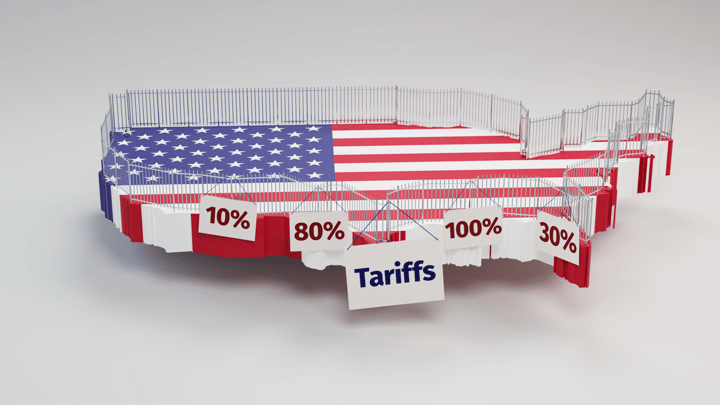
Your Offshore Mold Quote May Already Price In Tariff Evasion Risk
If your offshore mold quote comes in at or below China-direct cost, demand origin documentation before you sign the purchase order. A White House report, covered by Plastics Today in August 2026, identified a transshipment network routing Chinese goods through more than 40 nations to evade US tariffs, costing American manufacturers an estimated $60 billion annually. Section 301 tariffs on injection molds under HTS Chapter 84 run at least 25 percent. Our injection molding consulting work starts by auditing exactly this risk.
Source: Plastics Today, published 2026-08-14T19:52:33+00:00. Fair use for editorial commentary.
What the White House Actually Found: 40-Plus Nations Routing Chinese Goods Around US Tariffs
The White House report identifies a coordinated scheme in which Chinese-origin goods enter third countries, receive minimal processing or relabeling, and then ship to the US with certificates claiming origin in Vietnam, Thailand, Malaysia, Mexico, or one of more than 40 other transit nations. Plastics Today reported the scheme costs American manufacturers an estimated $60 billion annually in lost revenue and displaced jobs.
For the injection molding and moldmaking sector, the math makes the motive obvious. A 16-cavity hot-runner tool for an automotive interior component runs $80,000 to $250,000 depending on complexity and steel selection. At a 25 percent Section 301 rate, the tariff on a single mold import reaches $20,000 to $62,500. That differential gives suppliers, freight forwarders, and in some cases US importers a strong financial incentive to accept or manufacture false origin paperwork.
The White House report names the plastics and manufacturing sectors specifically as enforcement targets. That is CBP receiving a policy directive to look harder at mold import filings starting now. If your offshore tooling program relies on a non-China origin declaration and you cannot document it, this development is a direct risk to your supply chain.
Why Injection Molds Are a High-Value Target in Transshipment Networks
Injection molds are an attractive target for origin fraud for three concrete reasons. First, tooling has a high unit value relative to its shipping footprint. A single complex mold on one pallet can carry $150,000 in declared value, and the 25 percent Section 301 tariff on that shipment is $37,500. A complicit freight forwarder can generate that savings for a client in three false origin filings.
Second, mold origin documentation is genuinely complex. A tool built in Dongguan may use P20 steel from a US-linked mill, hot-runner manifolds manufactured in Germany, and hydraulic cores machined in Vietnam. Legitimate supply chain complexity and fraudulent complexity look similar on paper. That ambiguity is the opening that transshipment schemes exploit.
Third, the CBP substantial transformation rule under 19 CFR Part 134 requires that the declared country of origin be where the good was substantially transformed, meaning where the processes that give the article its core character were performed. For an injection mold, that means the cavity and core machining, EDM work, and final dimensional qualification must occur in the declared country. Routing complete-but-unmarked mold cores through a bonded warehouse in Thailand does not satisfy substantial transformation. Only the machining does.
How to Tell Whether Your Offshore Mold Supplier Is Running a Compliant Origin or a Paper One
The signals are readable if you know what to request. Below is the framework our team uses when vetting offshore suppliers for country-of-origin compliance before an RFQ goes out.
| Factor | Legitimate Origin Country | Transshipment Red Flag |
|---|---|---|
| Factory audit trail | Facility has verifiable cavity machining equipment, active CNC programs, and floor records matching declared mold specs | Facility shows assembly or fitting work only; no evidence of EDM, hard-turning, or cavity machining in the declared country |
| Tooling steel sourcing documentation | Steel purchase orders from regional distributors with mill certificates delivered to the declared country | Mill certificates show Chinese origin with Dongguan or Shenzhen delivery addresses; or certificates are missing entirely |
| Sub-assembly origin | Hot runners, hydraulic cores, and electrical components declared from their actual countries of manufacture | Sub-assemblies listed as same-country when vendor invoices show Chinese part numbers or Shenzhen shipping origins |
| Lead time vs. claimed country capacity | Lead time matches actual machining capacity in the declared country, typically 14 to 20 weeks for a complex tool built there | Lead time is 8 to 10 weeks for a country where mold machining infrastructure is thin or recently established |
| HTS country-of-origin declaration | Declaration matches factory audit; supported by Manufacturer’s Affidavit and Certificate of Origin with verifiable seal | Generic Certificate of Origin with vague process descriptions; no Manufacturer’s Affidavit; no third-party inspection report |
| Price relative to China-direct cost | Price runs 5 to 15 percent above China-direct pricing, reflecting genuine overhead and logistics cost in the third country | Price matches or beats China-direct pricing with a non-China origin claim; the numbers do not add up unless someone is absorbing the tariff another way |
What Legitimate China-Plus-One Tooling Looks Like Versus What Tariff Arbitrage Looks Like
A real China-plus-one tooling strategy takes 18 to 36 months to build properly. It requires a supplier with actual machining infrastructure in the third country, trained moldmakers on the floor, and a qualification process that proves the new facility can hold the same tolerances as the original Chinese shop. We are talking 5-axis CNC machining centers, wire EDM and sinker EDM equipment, CMM rooms, and moldmakers who can hit a 0.001-inch cavity tolerance on a customer print.
We have vetted two Vietnamese toolmakers that run legitimate operations under this standard. Both quote 8 to 12 percent above the equivalent China-direct price because their overhead and logistics costs are genuinely higher. That premium is the signal. When a Vietnam or Thailand quote matches or beats China pricing on a complex multi-cavity tool, someone is absorbing the cost difference somewhere, and the most common explanation is that the mold is still being built in China.
Legitimate substantial transformation under 19 CFR Part 134 and CBP guidance requires that the machining, EDM, and dimensional qualification occur in the declared country. Final fit-and-finish and nameplate installation do not satisfy the standard. Routing mold components through a bonded warehouse does not satisfy the standard. Only the machining satisfies the standard.
What Happens to Your Program If CBP Flags Your Mold Shipment as Transshipment Evasion
The importer of record is your company, not your supplier or freight forwarder. Under 19 USC 1304, CBP penalties for false country-of-origin declarations can reach four times the unpaid duty amount, plus potential seizure of the goods. If CBP holds your mold at port, your T1 date moves immediately. A 10-week customs hold does not just cost you the mold. It costs you the production run the mold was scheduled to start.
Beyond the immediate penalty, CBP can issue a Withhold Release Order against a supplier entity, blocking all future shipments from that source. If your supplier receives a WRO while your T2 tool is in transit, you lose the entire program qualification timeline. In active WRO cases, replacement sourcing typically adds 16 to 24 weeks to program schedules while a compliant supplier is qualified.
CBP can also apply retroactive duty assessments in transshipment enforcement actions, covering up to five years of prior imports under the statute of limitations for customs fraud. If your previous tooling programs used a transshipment supplier, you may already carry unpaid duty exposure in your import records that a CBP audit could surface.
Do not wait for CBP to audit your supplier. Audit your supplier before the first RFQ goes out, using documentation standards that a CBP entry review would satisfy.
A Practical Supplier Due-Diligence Checklist Before Your Next Offshore Tooling RFQ
Run through this checklist before issuing an RFQ to any offshore mold supplier that will declare a non-China country of origin.
- Commission a third-party factory audit from SGS, Bureau Veritas, or an equivalent firm. The audit scope must include a floor walk of the machining department and a verified list of active CNC and EDM equipment at the declared facility.
- Request tooling steel mill certificates showing purchase origin and delivery address in the declared country. Mill certificates addressed to Guangdong or Shenzhen are a hard stop.
- Request a Manufacturer’s Affidavit signed by the factory owner attesting that cavity and core machining and final dimensional qualification occurred at the declared facility.
- Pull the sub-assembly vendor list and verify that hot-runner manifolds, valve gates, and hydraulic components are declared from their actual countries of manufacture, not repackaged under the mold’s declared country.
- Compare the quoted lead time against the realistic production capacity of the declared country. A 32-cavity complex tool from a new Malaysian facility quoted at 9 weeks is a flag. Ask specifically what work is occurring in China.
- Confirm the HTS classification, either 8480.71 for injection-type molds or 8480.79 for others, and verify the country-of-origin declaration matches your factory audit. Resolve any discrepancy with your customs broker before committing to the supplier.
- Build a contractual country-of-origin warranty into your purchase order. If the supplier’s declared origin is found false by CBP, the supplier is contractually liable for duties, penalties, and documented program delay costs. Get this in writing before your tooling deposit clears.
If you need a partner to run this due-diligence process for an active sourcing decision, our injection molding consulting team handles supplier vetting for offshore tooling programs. For tools already in flight where documentation gaps are surfacing, our injection molding tooling project management service can establish an audit trail and inspection cadence before your next shipment arrives at port.
Frequently Asked Questions
Does buying injection molds from Vietnam or Thailand still expose me to Section 301 tariffs if the steel came from China?
Not automatically, but it can. CBP evaluates substantial transformation, not just where the raw material originated. If the mold underwent cavity machining, EDM work, and dimensional qualification in Vietnam or Thailand, the Chinese steel does not control the tariff classification. If the mold was only assembled or relabeled in the declared country, CBP will look through the paper origin and apply Section 301 rates as though it shipped directly from China.
How do I verify my offshore mold supplier is not routing Chinese-made tooling through a third country?
Request a third-party factory audit, tooling steel mill certificates, a Manufacturer’s Affidavit, and a sub-assembly vendor list. Cross-check the quoted lead time against realistic machining capacity in the declared country. A mold quote that matches China-direct pricing with a Vietnam or Thailand origin is the most consistent red flag in our supplier vetting experience. Price and lead time together tell most of the story before you ever commission an audit.
What documentation do I need to prove my injection mold was legitimately manufactured in the declared country of origin?
At minimum: a third-party factory audit report, tooling steel mill certificates with delivery addresses in the declared country, a Manufacturer’s Affidavit, a Certificate of Origin with verifiable seal, and a sub-assembly vendor list. For tools valued at $100,000 or more, add a pre-shipment inspection report from SGS or Bureau Veritas that includes dimensional qualification records tied to the declared facility.
What penalties does a US importer face if CBP determines a mold shipment evaded tariffs through transshipment?
Under 19 USC 1304, CBP can assess penalties up to four times the unpaid duty amount for false country-of-origin declarations. The importer of record is your company, not the supplier or freight forwarder. CBP can also seize the goods, issue retroactive duty assessments covering up to five years of prior imports, and refer egregious cases to the Department of Justice for criminal prosecution.
Is a lower-than-expected offshore mold quote a sign the supplier is pricing in tariff evasion risk?
Often, yes. A legitimate China-plus-one supplier with real machining infrastructure will quote 5 to 15 percent above China-direct pricing because their overhead and logistics costs are genuinely higher. When a quote matches or beats China pricing with a non-China origin declaration, the most likely explanations are that the mold is being built in China and transshipped, or the supplier is absorbing the tariff exposure on your behalf without disclosing it on the entry filing.
How does the White House tariff evasion crackdown change our sourcing strategy for the next tooling program?
It means CBP enforcement will intensify, not ease. Programs that cleared with thin origin documentation in 2024 face a higher review probability in 2026 and 2027. Treat country-of-origin documentation as a program deliverable, the same as your T1 inspection checklist. Build your supplier due-diligence process before the RFQ goes out. The window to catch a bad supplier is before the tooling deposit, not after the WRO arrives.
Need Expert Injection Molding Guidance?
From offshore tooling strategy to moldflow analysis, MoldMinds brings 15+ years of hands-on expertise to your project.
Get a Free Consultation →