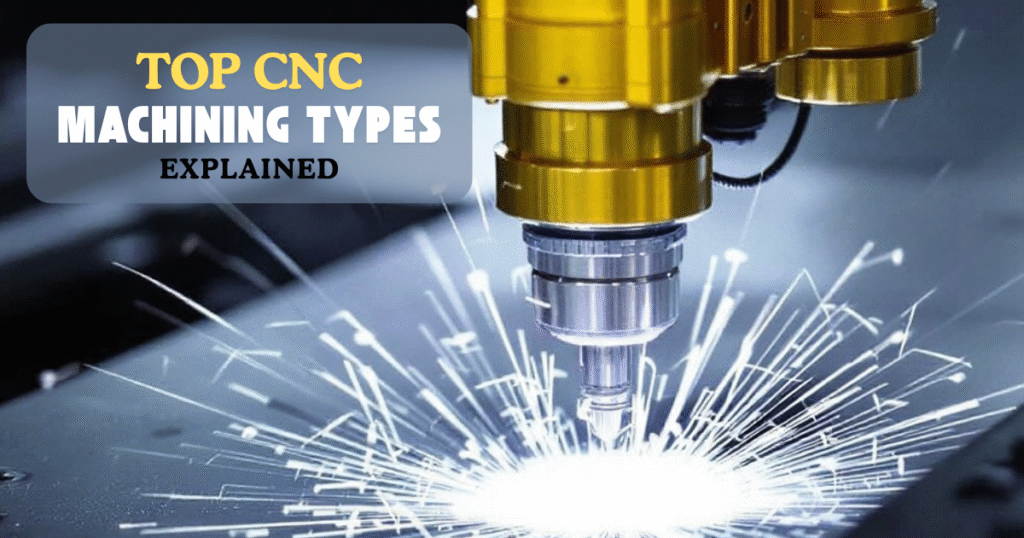
CNC Machining Types
The definitive guide to computer numerical control machining. From milling to laser cutting, master every technology that shapes modern manufacturing.
What Are CNC Machines?
CNC (Computer Numerical Control) machines represent the pinnacle of precision manufacturing—automated systems that transform raw materials into finished components with micron-level accuracy.
These sophisticated systems interpret digital instructions to control cutting tools, workpiece movements, and operational parameters. Where traditional machining relied on manual skill, CNC technology delivers consistency, speed, and complexity that would be impossible by hand.
The result? Production capabilities that have revolutionized aerospace, automotive, medical devices, and virtually every industry that demands precision parts.
The 5 Essential CNC Machining Types
Every manufacturing operation starts with understanding these foundational technologies. Each type serves distinct purposes, materials, and precision requirements.
CNC Milling Machines
01The workhorse of modern manufacturing. Rotating cutting tools remove material along multiple axes, creating everything from simple flat surfaces to complex 3D geometries. The most versatile CNC type, found in nearly every machine shop on the planet.
CNC Lathes (Turning Centers)
02Cylindrical perfection. The workpiece rotates while stationary tools shape it—ideal for shafts, threads, and any round component. Modern turning centers with live tooling can drill and mill while the part spins, combining operations in a single setup.
CNC Routers
03Scale meets versatility. Built for larger workpieces in softer materials—wood, plastics, aluminum, composites. Essential for furniture, signage, and architectural components. Where milling machines offer precision, routers deliver expansive working envelopes.
CNC Plasma Cutters
04Raw power for metal fabrication. Superheated plasma arcs slice through thick steel and conductive metals at speeds mechanical tools can't match. The go-to solution for structural steel, plate work, and heavy fabrication where edge finish is secondary to throughput.
CNC Laser Cutters
05Precision at the speed of light. Focused photons cut, engrave, and mark with unmatched edge quality and minimal material waste. From thin metals to acrylics and even textiles—lasers handle intricate geometries that would be impossible with contact tools.
Understanding Axis Configurations
The number of axes determines what geometries a machine can produce. More axes mean more complex parts in fewer setups—but also higher investment and programming complexity.
- Machine complex geometries in a single setup—no repositioning errors
- Reach undercuts, deep cavities, and compound angles impossible on 3-axis
- Superior surface finishes from optimal tool orientation
- Reduced cycle times through continuous 5-axis interpolation
CNC Operations & Capabilities
Beyond machine types, understanding individual operations reveals what's actually happening at the tool-workpiece interface. These fundamental processes combine to create finished parts.
CNC Machine Selector
Answer three questions about your project requirements and we'll recommend the optimal CNC machining type for your application.
What material will you be machining?
What type of geometry do you need?
What's your production volume?
CNC Milling Machine
Based on your requirements, a CNC milling machine offers the optimal balance of capability, precision, and cost-effectiveness for your application.
CNC Machine Type Comparison
Quick reference for selecting the right CNC machining type based on key performance characteristics.
| Machine Type | Best Materials | Precision | Speed | Cost |
|---|---|---|---|---|
| CNC Milling | Metals, Plastics | ★★★★★ | ★★★☆☆ | $$$ |
| CNC Lathe | Metals, Plastics | ★★★★★ | ★★★★☆ | $$ |
| CNC Router | Wood, Soft Metals | ★★★☆☆ | ★★★★☆ | $$ |
| Plasma Cutter | Thick Metals | ★★☆☆☆ | ★★★★★ | $ |
| Laser Cutter | Thin Metals, Plastics | ★★★★☆ | ★★★★★ | $$$$ |
| 5-Axis Mill | All Metals | ★★★★★ | ★★★☆☆ | $$$$$ |
CNC Tooling Cost Estimator
Get a ballpark estimate for CNC machining costs based on project parameters. Actual costs vary by complexity, tolerances, and shop rates.
Quick Cost Calculator
Beta ToolCNC Programming Methods
Modern CNC machines speak G-code, but there are multiple paths to creating those instructions. The right method depends on part complexity and operator expertise.
Manual Programming
Writing G-code by hand. Still valuable for simple parts and troubleshooting. Understanding raw code gives operators deeper machine insight.
CAM Programming
Software generates toolpaths from 3D CAD models. The standard for complex parts. Mastercam, Fusion 360, and SolidCAM lead the market.
Conversational Programming
Machine-mounted interfaces with guided prompts. Ideal for job shops running varied simple parts without CAD models.
The Future of CNC Machining
CNC technology continues advancing. These emerging trends are reshaping manufacturing capabilities.
- Hybrid Manufacturing — Additive and subtractive in one machine. Print near-net shapes, then machine to final tolerance.
- AI-Powered Optimization — Machine learning optimizes feeds, speeds, and toolpaths in real-time based on sensor data.
- Micro-Machining — Miniature CNC systems creating components measured in microns for medical and electronics applications.
- Lights-Out Manufacturing — Automated tool changing, pallet systems, and in-process inspection enable 24/7 unmanned operation.
- Sustainable Machining — Minimum quantity lubrication, chip recycling, and energy-efficient drives reduce environmental impact.