Injection Mold T1 Trial: T0, T1, and T2 Explained
A structured injection mold T1 trial is the single biggest factor separating a mold that ships on time from one that bleeds $15,000 in rework and six weeks of schedule. Most programs fail at T1 not because of bad steel, but because teams skip the T0 dry run or arrive at the press without defined acceptance criteria. Here is exactly what each phase requires.
The T0, T1, T2 Framework: Why the Sequence Matters
The t0 t1 t2 mold trial sequence is a staged gate process. Each phase has a specific scope. Blurring those scopes is how programs end up repeating shots and burning tool budget before a single production-intent part exists.
T0 is a dry run. No plastic. The goal is to confirm mechanical function: mold open and close, ejection stroke, cooling circuit flow, slide and lifter travel, and parting line contact. T1 is the first shot mold trial, where you run plastic and evaluate geometry, fill, and gross defects. T2 is the optimization trial, where you dial in process parameters to achieve dimensional targets and cosmetic standards.
Skipping T0 costs you T1 shots. In our shops, a T0 dry run adds four hours of press time. Finding a kinked cooling line or a binding ejector at T0 costs four hours. Finding it at T1 costs an entire trial day plus steel work, which runs $800 to $2,400 depending on the correction.
T0 Dry Run: The Pre-Shot Checklist
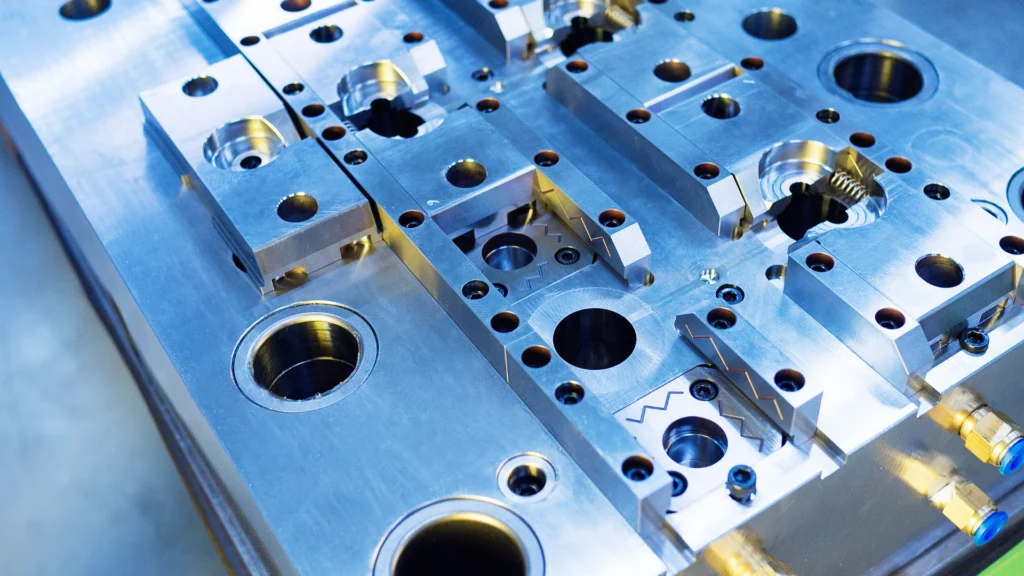
A T0 dry run has nothing to do with plastic. You are validating the mechanical and thermal infrastructure of the tool before any material touches it. Our project managers require a signed T0 checklist before any press time is booked for T1.
The core T0 inspection items are:
- Cooling circuit flow test: pressurize each circuit to 100 PSI and verify flow rate and zero leakage at all plugs and fittings
- Ejection system stroke: run the ejector plate through full travel and confirm return with no binding, using P20 or H13 guided pins as specified
- Slide and lifter travel: actuate every side action through full open and closed position and check for interference at parting line contact
- Parting line contact: use layout bluing or pressure-sensitive film to verify even contact across the full shut-off surface
- Leader pin and bushing fit: confirm smooth engagement with no side play exceeding 0.0005 inches
- Gate and runner geometry: verify sprue bushing radius matches the machine nozzle, confirm runner dimensions match the approved steel drawing
- Venting depth: measure vent land depth at parting line; standard range is 0.0005 to 0.002 inches depending on material viscosity
If the mold is sourced offshore, a qualified pre-shipment inspection at the Chinese shop should cover most of these items. Still, we re-run the full T0 checklist at the receiving dock. Tools travel. Things shift.
T1 First Shot Trial: What You Are Actually Evaluating
The first shot mold trial is not a process optimization run. That distinction matters. At T1, you are shooting plastic to confirm that the steel produces the geometry and flow behavior the design calls for. You are not chasing dimensional print compliance yet. You are eliminating gross defects and confirming the mold is mechanically sound under thermal load.
For a typical T1, you run the injection mold debug sequence in this order: establish a baseline process at the resin supplier’s recommended melt temperature, fill to 95% short shot, then bump to full pack. Document everything. Shot size in ounces, injection speed in inches per second, pack pressure in PSI, cycle time in seconds, mold temperature in degrees F. Your T1 report is only as good as your process documentation.
The primary defects to evaluate at T1 are listed below, with their most common root causes:
| Defect | Most Likely Root Cause at T1 | Steel or Process Fix |
|---|---|---|
| Short shot | Insufficient venting or gate too small | Open vents; increase gate land or diameter |
| Flash at parting line | Clamp tonnage too low or parting line gap | Verify clamp tonnage; fit parting line steel |
| Sink marks | Wall thickness non-uniformity or low pack pressure | Add steel to reduce wall; increase pack time |
| Weld lines in critical areas | Gate location drives flow fronts to wrong area | Gate relocation; may require steel weld |
| Sticking at ejection | Draft angle below minimum or texture mismatch | Add 0.5 to 1.0 degree draft; polish draw direction |
| Burn marks | Trapped gas from insufficient venting | Add vents at last-fill location |
| Dimensional miss on critical features | Shrinkage rate incorrect in tool build | Verify material shrinkage; plan steel safe condition |
Shrinkage is where offshore tools most commonly miss. A polypropylene tool built to 1.5% shrinkage will consistently run short on thick sections where actual shrinkage reaches 1.8 to 2.2%. That is a steel-safe condition if the toolmaker built in the right allowance. If they did not, you are welding core steel at T2.
Injection Mold Debug: The T1-to-T2 Gap
The injection mold debug phase is the work that happens between T1 and T2. This is where you compile the T1 part report, prioritize defects by severity, and make steel decisions. Not every defect gets corrected before T2. Some get addressed at the process level. Knowing the difference saves you rework cycles and money.
We use a three-tier classification for T1 findings:
- Tier 1, stop-ship: dimensional miss greater than 50% of total tolerance band on a critical-to-function feature; unacceptable flash that cannot be controlled by process; ejection failure that risks tool or press damage
- Tier 2, correct before T2: cosmetic defects on Class A surfaces; weld lines in visible areas; gate vestige out of spec; sink on non-critical geometry
- Tier 3, monitor at T2: minor dimensional variation within the tolerance band; slight non-fill on non-structural sections; cycle time above target
A well-run T1 typically generates four to eight Tier 2 and Tier 3 items on a moderate-complexity tool. A poorly run T1 on an untested offshore tool can generate fifteen or more line items. We have seen this pattern repeatedly on tools sourced without a supplier qualification step. According to OESA supplier quality guidelines, unqualified offshore tooling programs have rework rates 40% higher than qualified-vendor programs.
T2 Optimization Trial: Locking the Process Window
The mold trial run at T2 is where you establish a repeatable process window and confirm dimensional compliance against the print. You are no longer looking for gross defects. You are running a Design of Experiments (DOE) or a systematic parameter study to find the center of the process window and document the sensitivity of key dimensions to process variation.
At T2, you run a minimum of 30 consecutive shots under stable conditions before pulling measurement samples. SPC data from fewer than 30 shots is statistically unreliable for Cpk calculations. Your target at T2 is Cpk greater than or equal to 1.33 on all critical dimensions before submitting a PPAP package.
The T2 trial also confirms cooling efficiency. You should be measuring mold surface temperature with a contact pyrometer or embedded thermocouple at multiple locations, and verifying that differential across the tool face stays below 10 degrees F. A 15-degree or larger differential at T2 tells you the cooling circuit layout needs redesign, which is expensive to correct in hardened steel.
Cycle time target is confirmed at T2. For a tool running ABS at 0.120 inch nominal wall with 60 degrees F water-cooled mold steel, a reasonable target cycle is 22 to 28 seconds. If you are running 38 seconds at T2, you have a cooling problem, not a process problem.
Buyer Sign-Off Criteria: What Approves a Trial
Sign-off criteria should be written before T0, not after T2. Your tooling purchase order should include the T1 and T2 acceptance criteria as contract language. Without it, every defect becomes a negotiation.
Minimum sign-off criteria for a production-release trial include:
- All critical dimensions within print tolerance on a minimum of five consecutive shots
- Cpk greater than or equal to 1.33 on critical-to-function features (30-piece sample minimum)
- Zero flash on parting line, slides, or lifters under production process conditions
- Gate vestige within the specification called out on the part drawing; typically 0.020 inches or less above nominal surface for most SPI Class 101 tools
- Cycle time at or below the cycle time stated in the tool design specification
- Surface finish matching the approved texture or polish standard; SPI finish grades A1 through D3 are the standard reference per SPI mold classification documentation
- Full PPAP submission package or equivalent dimensional report depending on customer quality system
For offshore tools, we require a video-documented T1 run at the supplier’s shop before shipment, plus a second T1 run at our facility after import. The cost difference between a T1 in China and a T1 in the US is real. Press time in Guangdong runs $35 to $65 per hour. Press time in Ohio runs $95 to $165 per hour. Catching a Tier 1 defect offshore saves you the trans-Pacific freight correction loop, which adds four to eight weeks and $3,000 to $7,000 in logistics cost per round trip.
Frequently Asked Questions
What is the difference between T0, T1, and T2 in mold trials?
T0 is a dry run with no plastic, used to verify mechanical and thermal function of the tool. T1 is the first shot mold trial, where you run resin to evaluate fill, geometry, and gross defects. T2 is the optimization trial, where you lock the process window and confirm dimensional compliance against print requirements.
How many shots should you run during a T1 trial?
A typical T1 trial requires 20 to 50 shots minimum to establish process stability and collect a representative part sample. The first five to ten shots are process setup. Shots eleven through thirty or more are your evaluation sample. Running fewer than twenty shots at T1 leaves you with insufficient data to characterize fill behavior and ejection consistency.
What causes most T1 failures on offshore injection molds?
The most common T1 failures on offshore tools are incorrect shrinkage compensation, parting line fit issues from inadequate spotting time, and insufficient venting. These three causes account for the majority of T1-to-T2 rework cycles we see on imported tools. All three are preventable with a thorough DFM review and a pre-shipment inspection before the tool ships.
Can you skip T1 and go straight to T2?
No. T1 and T2 have different scopes and different acceptance criteria. Skipping T1 means you are trying to optimize a process on a tool with potentially uncorrected gross defects. You will waste T2 press time and produce misleading dimensional data. The T1 phase is a gate, not an option.
Who should be present at a T1 mold trial?
At minimum: the tooling engineer responsible for the program, the process engineer who will own production setup, and a quality representative with measurement capability on-site. For offshore T1 trials, your supplier quality engineer or a third-party inspection service should be present. Having your design engineer available by video call during the first shots adds coverage when unexpected geometry issues appear.