confirms a 22 percent reduction is achievable with conformal cooling given the part geometry, bringing cycle time to 41 seconds and saving 11 seconds per shot cycle.
- Press rate assumption: $120 per hour (200-ton machine, US production)
- Savings per shot cycle: 11 seconds divided by 3,600 seconds per hour, times $120 = $0.37
- Tooling premium for conformal inserts (supplier quoted): $22,000
- Break-even: $22,000 divided by $0.37 = approximately 59,500 shot cycles
- At 300,000 shots per year: break-even reached in approximately 2.4 months of production
Change one variable and the math shifts substantially. At offshore press rates of $40 per hour, the per-shot savings drop to $0.12. The same $22,000 premium now takes 183,000 shots to recover. At 300,000 shots per year, that is still under 8 months. But programs running at 75,000 shots per year are looking at more than 2 years to break even on cycle savings alone.
Programs running fewer than 100,000 shots per year need a secondary driver to justify the conformal premium. Warpage improvement, cosmetic surface quality, or a Class 101 service life obligation can each make the case independent of cycle time. If none of those apply, conformal cooling is likely the wrong call for the program. Your moldflow analysis report should include this break-even calculation so you are not running it in your head during a supplier negotiation.
How to Write Conformal Cooling Into an Offshore Mold RFQ Without Getting Burned
Vague RFQ language is the most common reason conformal cooling programs go wrong. The supplier interprets ambiguity in their favor, which often means conventionally drilled lines with a conformal label on the drawing.
- Specify the manufacturing process by name. Write “DMLS or SLM conformal cooling inserts” rather than just “conformal cooling.” Straight-drilled lines routed around a mild contour do not qualify and will not deliver the simulation-predicted cycle reduction.
- Require the tool steel grade by designation. Acceptable AM grades: 1.2709 maraging steel or AM H13 equivalent, heat treated to 44 to 48 HRC. Include this in the tool specification sheet attached to the RFQ, not in a verbal clarification call.
- Require channel geometry sign-off before mold construction begins. The supplier must provide a 3D model showing channel layout, channel diameter, and distance-to-cavity measurements at all critical sections. This is your gate before any steel is committed to machining or fitting.
- Require a CMM inspection report on the printed insert at all mating surfaces before fitting. Define the dimensional tolerance in the RFQ. Do not negotiate it after T1.
- Require a T1 cooling uniformity measurement. At first shot, the supplier must provide mold surface temperature readings across the cavity face at the specified mold set temperature, captured by IR camera or thermocouple array. Document the baseline at T1 so you can detect cooling degradation over the tool’s service life.
- Lock the DMLS printing lead time as a separate contractual milestone in the mold schedule. If the print is subcontracted, require the bureau’s name in the contract and a signed lead time commitment from the mold shop. This single line item prevents most T1 date slippage on conformal cooling programs.
Our injection molding tooling project management practice builds this milestone structure into every offshore conformal cooling engagement. In our experience, T1 date slippage on conformal cooling tools almost always traces back to DMLS lead time that was not contractually secured before mold design started.
What Can Go Wrong at T1 and How to Catch It Before You Accept the Tool
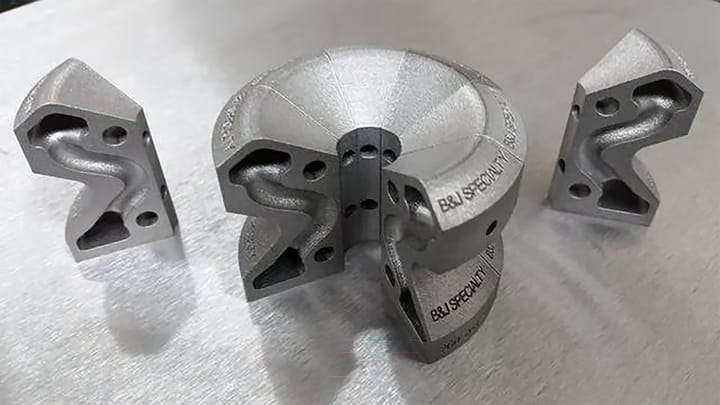
Conformal cooling programs fail at T1 in three predictable ways: insufficient cycle reduction, unexpected warpage, and channel leakage or blockage on first waterline hookup.
For cycle time: measure it against the moldflow simulation baseline, not against the old conventional tool. If the simulation predicted 22 percent reduction and you see 8 percent at T1, the channels were not built as designed. Pull the CMM inspection report and compare printed channel dimensions against the approved model. Deviations of more than 0.5mm on channel diameter or offset from cavity wall are common with poorly qualified AM bureaus and show up directly in cooling performance data.
For warpage: run first shots at the mold temperature specified in the simulation. Run at steady state, not on a cold tool. Measure part dimensions at 24 hours post-ejection, because residual stress from uneven cooling often shows up in late shrinkage that is not visible at the press. Compare all critical datums against the approved drawing at full tolerances before you sign off on T1.
For leakage: pressure test each conformal cooling circuit at 1.5 times operating pressure before any plastic is run. DMLS-printed channels have a rougher internal surface than drilled lines, with an average Ra of 10 to 20 micrometers as-built. This surface retains moisture and accelerates corrosion if the coolant circuit is not properly flushed and treated at startup. Confirm your supplier used a corrosion-resistant AM alloy and performed a channel flush and pressure hold before shipping the tool.
If T1 shows a cooling failure, do not accept the tool. Document the discrepancy against the RFQ specification and T1 acceptance plan in writing. Our tooling project management team handles these escalations with Chinese suppliers regularly and knows which corrective actions resolve in the field versus which require a reprinted insert. The written specifications you build into your RFQ are the only documented position you have once the tool is on a ship.
Frequently Asked Questions
How much more does a conformal cooling mold cost than a conventionally drilled tool?
The premium typically ranges from 20 to 60 percent above the cost of equivalent conventionally drilled inserts, based on published application data from EOS and Renishaw. Insert work usually represents 20 to 40 percent of total mold cost, so a 40 percent insert premium translates to roughly 8 to 16 percent on the complete mold price. Programs with simpler geometries and larger insert volumes will sit at the lower end of that range.
Can Chinese injection mold shops produce conformal cooling channels with metal 3D printing?
Yes, but verified capability is concentrated at a minority of Tier 1 shops. Credible suppliers include shops in Dongguan, Shenzhen, and Xiamen that operate EOS, Renishaw, BLT, or Farsoon equipment. Many shops without in-house equipment subcontract to AM service bureaus. Both arrangements can work if you qualify the bureau directly, review their quality documentation, and lock printing lead times contractually before the mold design phase starts.
What cycle time reduction should I realistically expect from conformal cooling on a multicavity tool?
Plastics Today cites up to 70 percent, the high end for complex geometries where conventional cooling leaves large hot spots. On a moderate-complexity part with ribs and curves, 20 to 35 percent is realistic. Simple flat parts with good conventional cooling access may see 10 to 15 percent. A moldflow analysis with conformal channel geometry modeled gives you a program-specific number before you commit to the tooling premium.
Is conformal cooling worth the investment for a program running under 100,000 shots per year?
Rarely on cycle time savings alone. At 100,000 shots per year with a $20,000 tooling premium and US press rates, break-even on cycle savings takes 2 to 3 years. The exception is when conformal cooling resolves a warpage or cosmetic defect that conventional cooling cannot fix. In those cases, the value is quality-driven and the break-even calculation uses scrap rate and rework cost instead of cycle time savings. Run both scenarios before you decide.
What metal 3D printing process, DMLS or SLM, is used to build conformal cooling mold inserts?
Both are used in production. DMLS (Direct Metal Laser Sintering) is the EOS process and is the most widely available at Chinese Tier 1 shops that have invested in metal AM. SLM (Selective Laser Melting) achieves full melt density and is available through Renishaw, SLM Solutions, and BLT equipment. In practice, the process matters less than the tool steel grade and post-processing protocol: vacuum heat treatment and channel surface treatment to control corrosion risk.
How does conformal cooling affect mold maintenance intervals and insert longevity over a production run?
Conformal inserts require more active maintenance than conventionally drilled cores. Internal channels are harder to inspect and flush; corrosion risk is higher if the printed alloy or post-processing was not correctly specified. Plan borescope inspection at every 100,000-shot interval on Class 101 and 102 tools per the Plastics Industry Association’s guidelines. A well-built DMLS insert in 1.2709 maraging steel with proper heat treatment can match conventional insert longevity, but passive maintenance schedules are not sufficient.
If your next program is a candidate for conformal cooling, our moldflow analysis will confirm whether your geometry and resin will actually capture the cycle reduction before you commit to the tooling premium. Run the simulation first, then build the business case from real numbers, not published averages.