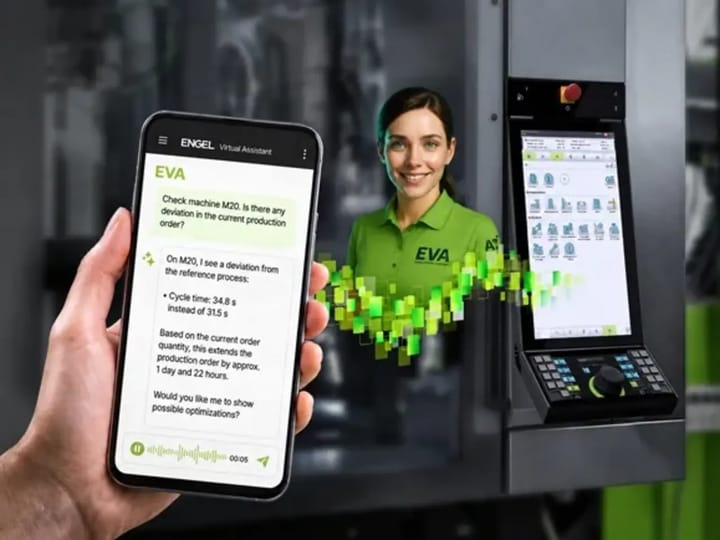
Engel EVA Runs the Machine Now: The Offshore Tooling Gap It Exposes
Engel’s Virtual Assistant EVA moved from recommending process corrections to executing them autonomously at Fakuma 2026. As reported by Plastics Today, EVA now makes approved machine parameter adjustments without operator intervention, marking the first commercial deployment of true closed-loop autonomous control on a production injection molding machine. That shift changes what a capable offshore supplier looks like. Every US OEM using injection molding consulting to qualify offshore tooling sources needs to update their supplier vetting criteria before their next RFQ.
Source: Plastics Today, published 2026-09-11T12:19:19+00:00. Fair use for editorial commentary.
What Engel EVA Actually Does: From Advisory AI to Autonomous Machine Control
Engel EVA is the first commercially deployed AI on an injection molding machine that executes parameter corrections autonomously, within pre-approved bounds, without waiting for an operator to act.
Previous AI tools in plastics processing worked like a dashboard warning light. They flagged process drift, surfaced recommendations, and waited for a technician to respond. According to Plastics Today’s Fakuma 2026 coverage, EVA operates within a pre-approved adjustment envelope set by the process engineer. Inside that envelope, it detects parameter drift and executes corrections without a human in the loop. The operator defines the bounds at setup; EVA manages the process within them during production.
That distinction matters in a way that is easy to understate. When a machine self-corrects a drop in melt temperature at 2 AM during a third-shift run with no process engineer monitoring the press, part quality does not depend on who is watching the dashboard. The process window holds because the machine holds it.
Why the Line Engel Just Crossed Matters More Than Any Previous AI Announcement in Plastics
EVA converts the AI system from an alarm into a control mechanism. Every prior machine-builder AI announcement in plastics was still an advisory tool. This is not.
Every equipment cycle brings new AI feature announcements from machine builders. Most of them are monitoring dashboards with statistical alerts. They show you the problem after the fact. They do not solve it during the shot.
EVA executing adjustments autonomously changes that. The performance gap between a machine running EVA-class control and a machine running a basic SPC monitor is not a software version difference. It is a fundamental change in how the process gets defended when conditions drift and no one is paying close attention.
For OEMs running high-cavitation multicavity tools offshore, that gap is now a production quality risk. If your supplier’s machines cannot hold process windows autonomously, your Cpk in production depends entirely on the skill and attentiveness of whoever is running the press on a Sunday night third shift. That is a real program risk, not a theoretical one.
Autonomous Process Control and Offshore Tooling: The Capability Gap US OEMs Need to Measure
The gap between offshore suppliers that can and cannot support closed-loop autonomous process control is wide enough to affect production Cpk, and current qualification practices do not measure it.
Here is the question the trade press is not asking: what share of Chinese injection molding suppliers currently run machines with closed-loop autonomous process adjustment capability?
No published industry benchmark from CAAM, MAPI, or the American Mold Builders Association answers that precisely for the current period. What we see across our offshore qualification programs is that machine capability varies enormously across Chinese Tier 1 and Tier 2 molders. Facilities running Engel, KraussMaffei, or Arburg equipment with current control software have the hardware foundation for EVA-class autonomous control. Facilities running domestic Chinese brands present a wider range of capability. Haitian International Holdings, the world’s largest injection molding machine builder by unit volume, produces machines across multiple control generations, and the capability of any specific Chinese supplier depends on when they purchased their presses and what they have upgraded since.
This is not a blanket statement about Chinese manufacturing quality. It is a statement about installed base reality. The global pool of machines with autonomous closed-loop process control capability is still small relative to total machine count. US OEMs who do not add machine control capability to their supplier vetting criteria will not know which side of that gap their supplier sits on.
What Closed-Loop AI Adjustment Means for Cycle Time, Cpk, and Scrap Rate in Practice
Autonomous process control defends the process window during production, not just during a PPAP qualification run. That changes the math on three metrics your program tracks.
Cpk
A minimum Cpk of 1.33 is the standard floor for automotive qualification under AIAG guidelines and for most medical injection molding programs. Without autonomous correction, production Cpk reflects the aggregate of operator response time, shift-to-shift consistency, and ambient condition changes across a long run. With closed-loop control, the machine compensates for those variables continuously. Engel has not yet published documented Cpk improvement data from commercial EVA deployments, but the mechanism by which it narrows long-run process variation is straightforward and well-supported by closed-loop control theory.
Cycle Time
Without autonomous control, process engineers set hold times and cooling times conservatively to buy insurance against parameter drift they cannot monitor shot by shot. If the machine holds the window itself, you recover that insurance margin. Even one second recovered on a 32-cavity tool running a 30-second cycle adds roughly 2,880 additional shots per 24-hour shift. At a part cost of two dollars per shot, that is $5,760 per day recovered from conservative cycle padding alone.
Scrap Rate
Short shots, flash, and sink marks that result from process drift get caught and corrected before the next shot rather than after an inspection cycle identifies the problem. The value of that correction depends on your part cost, your rework rate, and how many shots run between inspection intervals. On a high-cavitation tool, uncorrected parameter drift can fill a full carrier of off-spec parts before a manual inspection flags the issue.
How to Factor AI Machine Capability Into Your Offshore Supplier Vetting and RFQ Process
Adding a machine control capability section to your offshore RFQ is the most direct way to measure this gap before you commit to a supplier.
Your current supplier questionnaire probably asks about machine tonnage range, number of presses, ISO certification, and maximum shot size. It almost certainly does not ask what machine control technology the supplier runs or whether any of their presses support closed-loop autonomous process adjustment.
That omission now carries production risk. Here is how to close it.
| Capability | Advisory-Only AI (Previous Generation) | Autonomous Control (Engel EVA Model) |
|---|---|---|
| Process adjustment trigger | Operator reads alert and decides to act | System detects drift and acts within pre-approved parameter bounds |
| Response latency | Minutes to hours depending on operator availability and shift coverage | Shot-to-shot correction within the same production run |
| Operator requirement at adjustment | Skilled operator required to evaluate and respond to each alert | Operator sets bounds at setup; machine manages within them during production |
| Audit trail for PPAP | Manual log entries; adjustment history depends on operator discipline | Automated log of every adjustment with timestamp and parameter delta |
| Applicability to offshore shops | Available on most modern machines regardless of brand | Requires current-generation machine hardware and compatible control software |
| Risk to qualification status | Undocumented adjustments may conflict with IATF 16949:2016 process control requirements | Automated audit trail supports IATF 16949:2016 and PPAP Level 3 documentation requirements |
The table above shows why machine control capability affects your qualification timeline, not just your scrap rate. An autonomous system generates a complete audit trail automatically. An advisory system depends on the operator to document every adjustment they make under pressure during a production run, at 2 AM, on the third shift, when no one is auditing their log discipline.
Add these questions to your offshore RFQ as a dedicated machine capability section:
- What injection molding machine brands and models does your facility run, and what year were they purchased?
- Do any of your machines have closed-loop autonomous process adjustment capability? If yes, which machines and which active programs use it?
- What machine connectivity protocol do you use for data integration? OPC-UA, CC-Link IE, or proprietary?
- Can you provide a real-time process data feed to our quality team during production runs?
- How are mid-run parameter adjustments documented for PPAP Level 3 submissions?
What US OEMs Should Require From Injection Molding Partners Before This Becomes the Production Standard
EVA at Fakuma 2026 is a production-validated preview of where the entire machine builder market is heading. Closed-loop autonomous process control will be a standard option on new machines from multiple OEM builders within the next equipment purchasing cycle. The question is not whether your offshore supplier will eventually need this capability. It is whether you are qualifying suppliers now who have the machine infrastructure to adopt it as the technology spreads.
Do not make autonomous AI control a pass-fail requirement today. The installed base is too small and the technology too new to apply as a binary screen. Do add it as a scored capability in your supplier evaluation matrix. A supplier running current-generation Engel, KraussMaffei, or Arburg machines is positioned to add EVA-class control as the software matures and rolls out. A supplier running machines that predate OPC-UA connectivity is not positioned the same way, and that gap will widen over the next five years.
For programs launching new offshore tooling in the next 18 months, we specify OPC-UA machine connectivity and real-time process data export as a baseline requirement in new supplier agreements. That requirement is achievable today across a range of machine brands. It gives you the process data access you need now and positions the program to take advantage of autonomous control capability as it becomes more widely available across the supplier base.
If your team is preparing an offshore RFQ and needs help building a machine capability scorecard into your qualification process, our injection molding consulting team runs offshore supplier vetting programs that include technology infrastructure assessment alongside traditional press list and quality system reviews. That combination catches the gaps a factory tour will not.
Frequently Asked Questions
These questions cover what OEM tooling teams ask most when evaluating how EVA-class autonomous control affects offshore supplier qualification and active program risk.
What exactly does Engel EVA do that traditional machine monitoring and SPC systems cannot?
Traditional SPC systems detect process drift and alert an operator. Engel EVA detects drift and executes corrections autonomously, within parameter bounds the process engineer has pre-approved at setup. The difference is not measurement capability. It is who acts on the measurement. EVA removes the human response delay from the correction loop entirely, so the process window gets defended on every shot, not just on the shifts when a skilled technician is available.
Does autonomous AI process control eliminate the need for a process engineer on the floor?
No. A process engineer sets the approved adjustment bounds during setup and process qualification. EVA manages within those bounds during production. Engineering judgment is still required for setup, T1 and T2 qualification, troubleshooting outside the approved envelope, and any process change that requires PPAP re-documentation. Autonomous control reduces floor monitoring burden during steady-state production. It does not replace the engineering function at program launch or at qualification milestones.
Are Chinese injection molding suppliers currently running AI-controlled machines, and how do I find out?
Some are. Facilities running current-generation Engel, KraussMaffei, or Arburg equipment have the hardware foundation for EVA-class control. Facilities running domestic Chinese brands vary widely by machine age and specification. The most direct way to find out is to ask in your RFQ: which machine brands does your facility run, what year were they purchased, and can you provide a real-time process data sample from an active production job? If they cannot provide live process data on request, they are not running closed-loop control.
Will autonomous machine parameter adjustments affect my PPAP approval or IATF 16949 qualification status?
Adjustments that stay within a pre-approved process envelope and are logged automatically by the control system are consistent with IATF 16949:2016 process control documentation requirements. A new PPAP submission is generally not required if the adjustments remain within the originally validated process window. The automated audit trail that systems like EVA generate supports qualification documentation more reliably than manual operator logs. Confirm this interpretation against your customer-specific requirements before finalizing supplier agreements that include autonomous control capability.
How does closed-loop AI control affect part-to-part Cpk and what metrics should I ask my supplier to report?
Closed-loop control reduces process variation over long production runs by correcting parameter drift before it compounds across multiple cycles. Ask your supplier to report Cpk at first article, at 24 hours into the production run, and at 72 hours. The gap between those three data points reveals process stability under real production conditions better than a first-article Cpk alone. A process defended by autonomous control should show a much narrower spread across those three checkpoints than an operator-managed process on the same machine.
Should I add AI machine capability requirements to my offshore tooling supplier agreements now or wait for the technology to mature?
Add connectivity and data access requirements now. Require OPC-UA machine connectivity and real-time process data export in any new offshore supplier agreement. These are achievable today across a range of machine brands and give you measurable process visibility regardless of whether the supplier currently runs autonomous control. Treat autonomous AI process control as a scored evaluation criterion now, and revisit it as a pass-fail requirement once the installed base at your target supplier tier makes it a practical standard to enforce.